Wednesday, May 16, 2012

X-treme botany

I feel like maybe I’ve been giving botany a bad rap, what with all of these examinations of plant families. I’ve been focusing on the so-called commercially important plant families, and of those, the ones that are commercially important mostly due to being delicious. This might give the impression that all the incredible genetic and functional diversity of plants exists only to give us more things to eat. Well, today we’re going to switch it up, and look at some seriously hardcore plants. Plants that live in incredibly hostile environments. Plants so tough that when you talk about how extreme they are, you have to spell it with just an x.

I got your fertile soils right here...

There are a lot of ways that an environment can be extreme, but today, we’ll focus on chemical extremes:  pH (acid and alkaline), and salinity. Believe me, this will keep us busy for quite a while.

Let’s start with pH. Extreme pH can be defined as anything falling outside the range of 5.5 to 6.5, which is where the bulk of plants do best. Plenty of commonplace graden plants like azaleas, dogwoods and blueberries thrive at a more acid pH, often in the 5.0 - 5.5 range. Once soil pH dips below 4.5, the soil is considered “strongly acid”, and most plants begin to suffer from the acidity (for further detail, wander back to this post), mostly in the form of nutrient deficiencies. Simplifying matters greatly, let’s leave it at “nutrient uptake is impaired at low pH”.

  And how!

Most plants, but not all. Some plants do very well at extremely low pH - river birch (Betula nigra) is known to enjoy pHs as low as 2, while pitch pine (Pinus rigida) in addition to tolerating a fire regime tolerates soils down to a pH of 3.4. How do they do it?

Well, remember from the last time we took a look at acid soils, there are two main problems to deal with. One, nutrient availability is low. Two, aluminum (Al) availability is high (and aluminum is toxic). These problems have a common solution - mycorrhizae! 
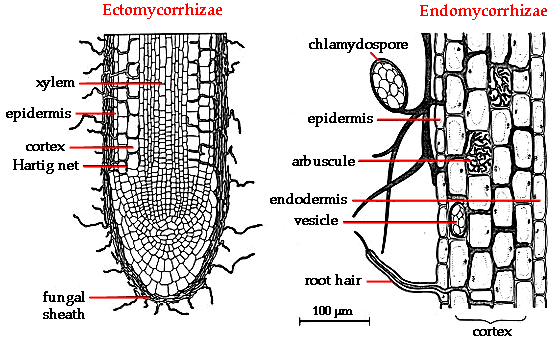
 From left to right, the art view and the technical view

Mycorrhizae are a family of fungi that grow in a symbiotic association with many plant species. Mycorrhizae do all kinds of cool things, including making nutrients more accessible. The explanation is simple - associating with a mycorrhizal network gives plants access to a huge amount of soil, without having to put out all of those roots. When nutrient uptake is limited or nutrient concentrations are low, having access to more soils means more nutrient uptake. Ok, so that should solve the low nutrient problem, but shouldn’t it also increase the Al problem? Not quite. Acid tolerant plants have been shown to block out Al with mycorrhizae - rather than be brought into the plant, Al accumulates harmlessly on the surface of the plant-mycorrhizae juncture.

So, one end of the pH spectrum can be managed, with a little help from some fungal friends. What about the other end of the spectrum, the high-pH, alkaline soils? As that image of nutrient availability shows, limitations kick in at higher pH as well - iron (Fe), for example, is often less accessible. So, some successful alkaline-tolerant plants have evolved efficient nutrient usage to limit any limitations. Mycorrhizae aren’t just for acid soils, either - plants growing in alkaline soils have been found to benefit from the increased nutrient access made possible by such a symbiotic fungal relationship.

Just like acid soils are plagued by both low nutrient availability and high Al concentrations, so alkaline soils have more than limited access to Fe to contend with. Here, the problem isn’t Al, but rather, salt. Extremely alkaline soils (pH of above 9) are the result of accumulated sodium carbonate - while salt is not the main limiting factor in such soils, plants must content with the salt to thrive. Remember, as we saw in our examination of dune plants, salt is not a friend to all living things. Plants in alkaline soils have been shown to excrete salts accidentally taken up, or to store water within the leaf in such a way as to dilute salts.

This makes a great segue to saline soils. Saline soils are (duh) saline, but not necessarily due to high concentrations of sodium. High concentrations of calcium, magnesium, potassium, chloride, and bicarbonate, among other things, can make a soil saline. Saline soils can be directly toxic to plants - chloride and sodium are both capable of damaging plant cells and tissues. Nutrient deficiencies are also an issue - high concentrations of the saline ions can make it more difficult to bring up actual nutrients, and sodium actively impairs nutrient uptake. Then there is the water issue.

What a wonderful place to be a plant.

There are a number of controls on how water moves in an environment, one of these controls being the concentration gradient. In brief, water moves down a gradient of solute concentration - water with lower concentrations of solutes moves towards regions of higher solute concentration, and eventually reaches a uniform solute concentration. This becomes a problem when in order to survive, a plant needs to maintain a lower solute concentration in water within the root - water within the root is attracted to the highly alkaline water outside of the root. Additionally, when the plant goes to take up water, it is forcing water to move in the opposite direction of the gradient. So, how do salt-tolerant plants cope with this?

Actually, there a couple ways to do this, including a really complicated arrangement of cell membranes in the roots, but to my mind, the most elegant solution is to create an osmotic gradient within the plant. Certain plants sequester either organic compounds or ions from the saline soils within certain parts of the plant, at greater concentrations than the ions within the soils. This has the effect of making the concentration of solutes higher within the plant than without, and driving water into the plant. It takes less energy for the plant to use ions taken up from the soil solution, and this also has the effect of harmlessly sequestering salts brought into the plant. Pretty cool, huh?

This is only scratching the surface of the extreme environments plants laugh at. In future posts, we'll look at plants which thrive in freezing temperatures, drought conditions, and unbelievably windy mountaintops. Not to mention the bacteria out there that regard acid mine drainage, petroleum derivatives and toxic chemical spills as a delicious breakfast buffet. Excited yet? 

Thursday, May 10, 2012

The fantastic four

Wow, can you believe that we’re nearly through the periodic table? I believe it was way back in March when I got the crazy idea to work through the entire thing. Fear not, Chemistry Wednesdays will continue, but the topics will get just a little bit more unpredictable. But, before we reach that point, we’ve got three more groups of elements to go through. We’ve looked at the metals, and the semi-metals. This can only mean one thing is coming up - the non-metals!

 
Helpfully marked in orange

Yes, the non-metals, a group of elements largely defined by what they are not. Also, a somewhat misleading name, as all non-metal elements are not metallic,but not all non-metallic elements are referred to as non-metals. Confused yet?

All right, remember in the good old days of the alkali earth metals, when everything was simple, and each group of elements simply consisted of one of those straight-down-the-table groups like Group I and Group II? Then along came the transition metals and screwed all of that up, by being very similar to one another across groups. As we move towards the right side of the table, groups become more distinctive relative to one another once again. The last two groups on the table are usually examined as separate categories, as is (sometimes) the third-to-last. We’ll look at those next week, as I don’t fancy covering carbon chemistry and oxygen chemistry in one post. Today, we’re going to look at a kind of catch-all group - those non-metallic elements that do not belong to one of the three distinctive final groups on the table. Don’t worry! There are only four of them!

Most of the elements in this group are clustered together. Most, but not all. Yes, today is the today when we finally look at hydrogen which, in spite of hanging out on top of Group I winds up being discussed along with carbon, oxygen (sometimes) and nitrogen (that little tetralogy of elements is the basis for an entire branch of chemistry, which we will get to in a moment).

Ok, so besides being excluded from the metal club, what exactly distinguishes non-metals from the pack? Well, they lack the properties of metals - ductility, ability to form alloys, tendency to efficiently conduct heat and electricity, etc. Non-metals also have more electrons in the valence shell, usually from four to eight electrons (remember the oddities of the d and f orbitals, which keep them from ever being proper valence shells). The non-metals we’re looking at today usually have four or five valence electrons (hydrogen, with only one electron, being the exception). With half-filled (or more) valence shells, the non-metals are more likely to bond in such a way as to fill the valence shell. Contrast this with the tendency of metals to shed valence electrons.

Non-metals, then, tend to either be the negative side of an ionic bond, or bond covalently. The elements we’re looking at today are all more likely to bond covalently - we’ll get to the ionic bonds next week. This tendency to form covalent bonds gives rise to a rather important bit of chemistry - organic chemistry.

Organic chemistry is defined as the branch of chemistry concerning carbon compounds. After carbon, the main elements involved in organic chemistry are hydrogen, oxygen and nitrogen, following the easy-to-remember acronym “CHON”. Phosphorus and sulfur are two common additional guests, and, not coincidentally, also in the non-metals group (although, again, oxygen and sulfur are sometimes separated out).

Organic chemistry is sometimes called the chemistry of life - it deals with the compounds that form all living tissue, from DNA bases to skin and sinew. Certain characteristics of the nonmetals, particularly carbon, are responsible for the primacy of organic chemistry in biology, so let’s focus on carbon for a little bit.

 
Thanks, organic chemistry!

Carbon (abbreviated C) is interesting, in that it is capable of covalently bonding with four other atoms at once, due to its 4 valence electrons (in an 8-max shell). Silicon, germanium and tin are also (theoretically) able to do this, but, to varying extents, all three of those elements are somewhat likely to give up some or all of their valence electrons, due in part to the presence of a d-orbital. Carbon is the only 4-valence electron element with no tendency to give up electrons, and thus almost always forms covalent bonds. Carbon is also the sixth-most abundant element in the universe. Combine these two things, and the fact that life on Earth tends to be carbon-based starts to make sense. Covalent bonds, after all, are possible between elements of all electron configurations (in contrast to metallic bonding), form easily at the standard range of temperatures on Earth (in contrast to a form of bonding we’ll look at in a few weeks), and don’t dissolve in water (in contrast to ionic bonding). That’s reassuring, isn’t it?

Nitrogen (N) has interesting bonding abilities, as well. Nitrogen has one more valence electron than carbon, and needs three additional electrons to form a full shell. Now, plenty of N atoms achieve this by bonding to three additional electrons, but some N atoms achieve this by forming a triple covalent bond to another N atom. In two triply bonded atoms, three pairs of electrons are shared, forming a very strong bond.Theoretically, any atom with the right range of electrons in the valence shell can form double or triple bonds (C, ever the overachiever, is capable of forming a triple bond with another C or N atom, and a single covalent bond with another atom, putting a certain amount of pizzazz into organic chemistry), but N is especially likely to form triple bonds. Two triply bonded N atoms form a stable molecule, as both have full valence shells. In its stable, 2-atom molecule, N exists as a gas. And not just any gas. Gaseous N makes up 78% of Earth’s atmosphere. Nitrogen is the fifth most abundant element in the universe, and plays all kinds of interesting roles in ecology. Which, one of these days, I will get into.

Phosphorus (P) behaves somewhat similarly to N, but a) the bonds aren’t as strong, c) there is a d orbital involved, and c) P has a tendency to spontaneously combust in air. Let’s make a very long story short and simply say that P has a very strong affinity for oxygen, and rapidly reacts with any available oxygen to form certain compounds. As you may remember from Group I chemistry, rapid reactions sometimes generate, well, fire. Who says organic chemistry is boring? Phosphorus is an important nutrient, and an ingredient in explosives. How many elements can you say that about?

That leaves hydrogen, our weird little outlier. Now, the reason we didn’t stick hydrogen in with Group 1 is that, in spite of having only one electron, hydrogen still has a half-full valence shell. So while hydrogen can lose that one electron, it’s just as likely to acquire another electron via covalent bonding. Hydrogen may exist as a gas (two hydrogen atoms can bond covalently forming a stable molecule), or in combination with another element - in fact, hydrogen naturally combines with every element in the periodic table, except for the ones at the bottom (they don’t exist in nature) and the Nobel gases (wait a few weeks for the answer to that one). Hydrogen is the most abundant element in the universe, comprising something like 90% of all matter. Hydrogen pops up everywhere from organic chemistry to fertilizers, to the hearts of stars, where it burns in a process that, if only we could understand exactly how it works, could fuel the future of humanity. 

Yeah, I'm a playa

Wow. That was a lot of information for four elements. Non-metals are quite the grab bag, eh?

Things that should not be in the ocean, Part I

Technical difficulties and life in general have not been cooperative in this week's rigid posting schedule. Fear not, we're getting a double post today.

 This past weekend, I was involved in a semi-serious conversation about using genetically engineered algae to turn plastic garbage into biodiesel. It’s an elegant solution, in a way - using the ever-growing avalanche of humanity’s own waste to power further growth. The idea raises two points - one, the science (and feasibility) of that kind of biodiesel production, and two, the availability of the medium (plastic waste). We’ll take a look at the microbiology part of the equation in a few weeks, but today, let’s look at plastic waste. And not just any plastic waste, but what I consider to be its most dramatic manifestation. Because really, there’s no way to start the week off right like the Pacific Garbage Patch.


 Wait, that’s it? I bet you were hoping for something more impressive. After all, isn’t the garbage patch a Texas-sized agglomeration of debris that can be seen from space? Shouldn’t it look something like this?


Not quite. The Pacific garbage patch is real, and a real threat, but it doesn’t quite look like that. It isn’t a solid island, and it can’t be seen from space. It doesn’t have a proper fixed location, either. Let’s look at this one term at a time, starting with “Pacific”. 


Ocean currents are fun. They arise from a combination of tides, differences in the density of water, and wind patterns (which, in turn, ultimately derive from the uneven heating of Earth’s atmosphere). In this case, we’re mostly concerned with the wind-driven currents. Global winds create what are called gyres within oceans - massive spirals of circulating water, with areas of relative calm in the middle. 


There are five main gyres out there - the North Pacific, South Pacific, North Atlantic, South Atlantic and Indian Ocean gyres. Way back in 1988, the National Oceanic and Atmospheric Administration predicted that there was a high likelihood of plastic debris accumulating in the calm area at the center of the North Pacific gyre. These predictions were confirmed by the discovery of high concentrations of plastic debris exactly where expected. It’s entirely possible (and highly likely) that debris are accumulating within the other gyres, however, the massive amount of “ground” to cover somewhat hinders the amount of sampling possible.

Ok, let’s move onto the “garbage” part of the phrase. The garbage is all plastic or plastic-derived - nothing else would float in water. The sources vary - about 80% comes from land, and of that, 65% comes from garbage. Garbage might be accidentally or intentionally dropped into a stream, washed off of a landfill (plastic has a regrettable tendency to float), or spilled in the process of being transferred from the home to the landfill. Other plastics make their way from the land to the sea when the plastic pellets used in manufacturing plastic goods are spilled into waterways. Finally, the remaining 20% or so is dropped, washed or dumped from ships directly into the ocean - this could be anything from a coffee cup washing off a fishing boat to a container being washed off a cargo vessel.

Once in the ocean, the plastics quickly degrade. Well, sort of. I’m going to swerve over into earth science here, and present a relevant (I think) concept. Weathering, in this context, describes the breakdown of rocks into smaller and smaller pieces (and eventually soils and mineral-rich water). There are two types of weathering, physical and chemical. Physical weathering is the physical breakdown of rocks - imagine a hammer smashing a rock into bits. The bits get smaller and smaller, but the chemical structure remains unchanged - quartz beach sand has the same chemical formula (SiO2) as a gigantic quartz crystal. Chemical weathering acts at the chemical level - the rock is dissolved or leached, and the resulting pieces have a chemical composition different from the rock pre-weathering. Plastic debris in the ocean can be understood to undergo physical weathering - the particle size is reduced, reduced, and reduced again, but the chemical structure remains the same. Even those compostable plastics that are coming into greater use don’t really dissolve in the oceans - compostable plastics are designed to dissolve under land conditions, not in oceans. You’re starting to see why “proper disposal” is so important with any kind of waste, right?

One more word about the garbage bit. The tendency of plastic waste in the ocean to become floating “microplastics” explains why you can’t see the patch from space. Much of the patch consists of a high concentration of microplastics in the upper portion of the water column.

 Plastic Ocean
Ok, so these are a little bigger than micro, but you get the point.


Now, a little more about the patch part of the phrase. We already know that the garbage patch is not actually a floating island of waste. Instead, it is an area with a high concentration of plastics relative to things that would normally be in the water column (plankton, for example) - typically within the patch, the concentration of plastic is greater than the concentration of plankton. The high concentration is a consequence of water movement being relatively restricted within the center of an oceanic gyre - plastic that finds its way in does not readily find its way out. The location and size of a given patch depend on the gyres. Now, is it possible for the location and size to shift?

Of course it is! Both the size and extent of the garbage patch change throughout the year, in combination with the shifting weather patterns. Given that the patch we’re focusing on is in the Pacific Ocean, there is also the (so-far uninvestigated) effect of the El Nino - La Nina cycle on the whole mess.

The patch is also, well, patchy. While concentrations of microplastics might be relatively constant throughout the entire estimated garbage patch, larger plastic debris are going to congregate in certain areas, as a result of more local tidal action. Reports of sailors in the North Pacific encountering floating piles of visible plastics are tied to these “sub-patches”. All of this makes it hard to pin down the exact location or extent of the garbage patch, and subsequently, hampers clean-up of the patch.

And do we ever need clean-up. All of this plastic in the ocean is not doing marine life any favors. There are the obvious problems, like suffocation or entanglement in larger pieces of ropy plastic - anyone who has ever cut up the plastic rings on a six-pack holder has been trying to avoid this outcome. There is also a more insidious threat, from the smaller plastics. A number of marine organisms feed on plankton, fish eggs, small fish, or other bits of tasty marine life floating on or near the surface. Now, what happens when the concentration of small pieces of plastic rises above the concentration of that upper-water column marine life?
 
Rather than insert a disturbing image, I suggest that the strong-stomached among you image search “albatross plastics autopsy”

Birds are particularly threatened. Take the increasingly unhappy case of the Laysan albatross, a truly remarkable bird. Like all albatross, these birds spend much of their lives flying over the open ocean - albatross are capable of both weathering harsh weather, and sleeping on the wing. Laysan albatross are particularly large representatives of the albatross family, with a wingspan that often reaches (or exceeds) 2 m. They only come ashore to breed, and that’s where the trouble starts. Laysan albatross prefer to feed their young on the fish eggs and small squid found in the upper water column. Much of the feeding range of Laysan parents happens to overlap with the North Pacific garbage patch. I won’t get into the (depressing) mechanics, but up to forty percent of Laysan albatross chicks born each year die from ingestion of plastics which their parents mistake for fish eggs. 


Microplastics
I shot the albatross

Clean-up of the garbage patch is difficult, maybe impossible. However, it’s very possible, even easy, to prevent the patch from getting any bigger. The damage is done, but we can prevent it from getting worse. Reducing, reusing and recycling plastics (in that order), along with taking pains to properly dispose of plastics (remember the biodegradable plastics problem) that can’t be reused or recycled can cut off the source for much of the plastic in the patch. Sure, there’s only so much we can do about containers being lost from cargo vessels, but that’s only 20% of the problem. The other 80% is up to you.

Friday, May 4, 2012

Don't breathe this

Today is a first in the admittedly short history of this blog. Not only do we have another "by request" topic, but that request has been filled by a guest author. So, thank you Marissa, for the topic suggestion, and a big round of thanks to Virginia, atmospheric chemist extraordinaire (and quite a good blogger). 

Mention ozone as an environmental issue, and most people think of the ozone hole: aerosol spray cans and styrofoam, skin cancer, and so on. Its discovery warranted a Nobel Prize for chemistry and also the Montreal Protocol, a highly successful forerunner to modern climate talks. While important, in a sense the ozone hole is nevertheless a faraway problem, and not just because most of us live in the Northern Hemisphere (and last year’s Arctic "ozone hole" remains up to semantic debate). The ozone layer, holed or otherwise, exists in the lower stratosphere. This is the part of the atmosphere where weather balloons give out, too high for commercial aircraft other than the Concorde, where the barometric pressure is less than 10% what it is at the surface. In other words, humans don’t breathe it.

This is just as well, because ozone is toxic stuff. Its chemical configuration, three oxygen atoms bonded together Mickey Mouse-fashion, is not especially stable. Ozone will readily react with organic molecules to reach a more stable arrangement, which makes it an oxidizer so effective it can kill living cells even at low concentrations. This makes ozone great for water treatment, where it is sometimes used in place of chlorine. Like chlorine, it’s not so great for your lungs.
 
Or for potato plants.

High ozone in the surface air is linked to childhood asthma, and it exacerbates heart and lung disease in those who already have it. Very high levels cause headaches, sore throats and sometimes permanent damage even in healthy people. While the threshold of danger varies greatly from person to person, this is more than enough reason for the EPA to include ozone in its air quality standards. US cities are in violation of the Clean Air Act if they allow surface ozone concentrations to rise too high.

This is where it gets tricky. To keep most pollutants in check, we track down whoever is emitting the offending substance and get them to stop. The EPA has a most wanted list full of freon smugglers. But hardly anyone emits ozone directly. Its chemical instability means that any given ozone molecule in the atmosphere is extremely short-lived. Virtually all of the freon that has ever been released to the atmosphere is still there today, but ozone lasts a matter of hours at most. If ozone were coming out of smokestacks, it wouldn’t have time to accumulate.

Instead, ozone comes from the reactions between chemicals we do emit: NOx and VOCs. NOx refers to the compounds NO and NO2 taken as a group; they’re emitted together when the nitrogen and oxygen in air react with each other at high temperatures (say, in a car engine). VOCs are volatile organic compounds, a group of compounds with many, many members. For the purposes of ozone chemistry, the important features VOCs share are that they exist in the atmosphere as gases, and they have at least one C-H bond that can be broken by reaction with OH.

In the reaction series below, VOCs are collectively written RH; the R is a placeholder for everything connected to the carbon end of the C-H bond. VOCs can be very large molecules, so this saves a lot of space. M is another placeholder, standing for either N2 or O2—it doesn’t matter which—acting to quench the extra energy without being part of the reaction. Those familiar with quantum mechanics will remember that denotes the energy of a photon. In this case, all it means is that sunlight is an essential part of the reaction.

RH + OH → R + H2O
R + O2 + M → RO2 + M
RO2 + NO → RO + NO2
NO2 + → NO + O
O + O2 + M → O3 + M

Because of that in the second-to-last step, ozone is only produced when the sun is up. Therefore the highest ozone concentrations occur in the heat of the day. On days with poor air quality, afternoon is when it’s best to stay indoors. The exception is when high levels of NOx and VOCs become trapped above the surface overnight due to boundary layer dynamics. Then there can be a sudden ozone spike in the mid-morning, as soon as the surface warms up enough to mix yesterday’s pollution back to the surface.

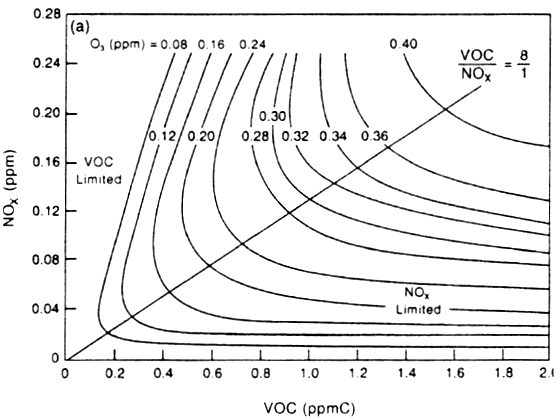
There’s also an ideal ratio between NOx and VOC concentrations, outside of which ozone will not form as efficiently. The relationship is complicated, to say the least. In the plot below, the diagonal line marks the ideal ratio; the curves are contours showing how much ozone will form given different combinations of NOx and VOC content.

Madness. Source: Finlayson-Pitts and Pitts 1993.

Look at that. If you wanted to control the ozone concentrations for a city in the upper left corner—high NOx relative to VOC content—you might sensibly make NOx your priority and reduce its emissions before trying to reduce VOCs. If you did, however, the ozone concentration would increase. You’d have moved vertically down the graph, across ozone contours and out of the VOC-limited regime.

Lastly, ozone formation reactions are temperature-dependent, and will take place faster in hot weather than in cooler weather. This is one more reason for heat waves to be compounded by poor air quality, and it’s especially unsettling in the face of climate change: we will have to reduce NOx and VOC concentrations simply to keep ozone levels constant as the subtropical climate zone expands into the midlatitudes (Seidel et al. 2007).

This is not to say we should give up on keeping ozone out of our breathing air. After all, ozone kills people. But it does show why the task is an ongoing challenge.

Wednesday, May 2, 2012

Postponed, but not forgotten

Happy chemistry Wednesday, everyone! Wow, can you believe we’re already at the midpoint of the week? Speaking of midpoints.... The astute of you may have noticed that we apparently skipped a bunch or elements back when we took a look at the transition metals. The trouble crops up in Group III, the first group of the transition metals. Going down the group, we see scandium, yttrium...and then a weird sort of cut-out, as lanthanum and actinium, the next two elements of the group, have been removed and placed below the table. Additionally, there are fourteen additional elements after lanthanum and actinium which have been removed from the table proper. What’s with the excision of these thirty elements? Are they not transition metals?


Look down

Not exactly. Today, we’re going to take a look at the world of the lanthanides and the actinides. Lanthanides are sometimes known by the supremely cool moniker of “rare earth elements” - this isn’t quite accurate, but we’ll get there in a moment. In many ways, this group of elements are similar to the transition metals, given that much of their behavior is the result of a partially filled electron orbital. However, the lanthanides and actinides are marked by a partly filled f orbital, in contrast to the partly filled d orbital of the transition metals. F orbitals are the final orbital in the “s, p, d, f” progression. They only come into play in elements with an atomic weight above 58, and never act as a valence shell. Similar to the transition metals, where s orbitals of the next level fill before the d orbital (it’s really strange, but I think the transition metals post a few weeks ago did a passable job of explaining the whole thing), s orbitals of the next level in the lanthanides and actinides fill before the f orbitals. Actually, several orbitals further out from the f orbitals fill first, leaving the f orbitals buried, and unlikely to be involved in any chemical reactions. 


A theoretical construct, true, but f orbitals are pretty weird-looking

Regardless of the order in which they fill, f orbitals contain a maximum of 14 electrons. As we move across the lanthanide and actinide series, the f orbitals fill in, while the number of valence electrons does not change. Again, as in the transition metals, the lanthanides and actinides are both relatively likely to shed the two electrons in the outermost s orbital. They are also likely to shed an electron from the d-orbital - thus, lanthanides and actinides tend to exist in a +3 ionic state.

Lanthanides and actinides have some interesting and useful chemical properties. We’ll start with the lanthanides and, as you’ll soon see why, magnetism.


This will make sense in a moment, I promise.

While a full examination of magnetism is somewhat beyond the scope of today’s post, I’ll see what I can cover in a paragraph. Remember the EM spectrum? Light, UV radiation, gamma rays - it’s come up a few times already, and no doubt will continue to do so. Now, the “EM” stands for electromagnetic (with “radiation” implied). All of those different kinds of radiation are fundamentally expressions of a coupled electric and magnetic force. EM radiation can be broken down into two opposite but equal waves, one magnetic, and one electric. Interestingly, for much of human history we understood electric and magnetic phenomena as two unrelated forces - it wasn’t until the 1850’s that Maxwell understood that the two were expressions of the same force, and produced the unifying mathematical proof. Now, electric force refers to the behavior of particles carrying an electric charge - positive versus negative, based on the difference in the number of cations and electrons within the atoms making up said particles. Magnetic force operates under the same principle of opposites attracting and likes repelling, but rather than the number of electrons, has to do with the direction of spin on electrons. Yes, electrons spin. Yes, the more you think about the universe, the more surreal it becomes. The behavior of magnetic fields makes for its own fascinating entry, so we’ll stick with permanent magnets. Any element with an incomplete electron shell can exhibit magnetic behavior, and elements that form certain kinds of solid structures can display permanent magnetism - all of the associated electrons spin in the same way, giving the entire structure a stable magnetic orientation. Magnetism can be stable on Earth because the entire planet is covered by a magnetic field (North and South poles, anyone?).  Metals tend to form these kinds of structures, and thus, metals can become stable magnets.

As a consequence of their incomplete f-orbitals and stable valence configurations, certain elements in the lanthanide series can form strong permanent magnets. These rare earth elements can complex with hydrogen and other metal atoms in order to form structures capable of generating an extremely strong magnetic field. If you want a more detailed explanation of how rare earth magnetism works, I invite you to peruse this publication by the Niels Bohr Institute. However, for practical purposes, just keep in mind that combining a rare earth element like neodymium or samarium with a transition element like iron or cobalt makes an unbelievably strong magnet with a small field size - the field is intense, but limited. One could use a rare earth magnet to apply a strong, targeted magnetic field in a situation where you would not want to accidentally expose other areas to magnetism (say, your computer hard drive).


The obligatory photo of a ridiculously strong magnet

For this reason, the rare earth metals are very important, commercially. The good news is, they actually aren’t that rare. Quite a few of the rare earth elements are actually more abundant than that perennial environmental bugbear, lead. The bad news is that the rare earth elements tend to be found in mineral complexes, and need to be painstakingly isolated before being used. It’s worth it, though. In addition to its use in rare earth magnets, samarium (Sa) turns up in the specialized lighting used on film sets, as a radiation-absorber in glass, and even in the flints in lighters. Neodymium (Nd) also turns up in lighters, as well as glass (where it imparts a violet or red tinge), welders’ goggles, artificial rubies and in magnets. Gadolinium (Gd) turns up in microwaves, metal alloys, and cathode ray tubes. Erbium (Er) is also used in metal alloys, as well as fiber optic cables and nuclear reactors. Other rare earth metals are less commercially important, but no less interesting.

The we have the actinides. You don’t hear as much about the actinides because, while all of them are theoretically possible and have existed at some point or another, most of them have only existed for short periods of time inside of supercolliders. Nothing past uranium (U), the fourth element out of the fifteen actinides, occurs naturally in usable quantities. All of the actinides are radioactive. Fans of astronomy will likely be amused by the progression of uranium, neptunium and plutonium. Plutonium, interestingly, while artificially created, is actually fairly stable - while it decays into U, it does through over a period of about 82 million years. Plutonium has been used to power several long-distance spacecraft. Plutonium’s precursor and destination, U, is also used as a power source, and less commonly, as a nuclear weapon. Uranium was also used at one point in the coloring of Fiestaware dishes - similar to the glowing radium watch fiasco of the early 20th century, this form of pigment was retired, as radioactive dinnerware is seldom considered a good idea. 

 If it can do this...

 It probably shouldn't be used for this

So, this neglected bit of the periodic table contains both the ingredients for unimaginably strong magnets, and nuclear weapons. They may be shunted off to the bottom of the table, but it really doesn’t pay to underestimate the lanthanides and actinides.